

with host artist Miriam Schulman
Many artists credit their work as a way to manage or deal with anxiety, depression and other forms of mental illness. Since October is Mental Health Awareness month, I wanted to share the stories of artists who found a way to deal with their illness by creating art.
In this podcast, you will discover…
Yayoi Kusama and Confronting Anxiety
Japanese artist Yayoi Kusama is known for her polka-dot art. She has been open about her mental health and shred that art has become her way to express her mental problems. In her words “I fight pain, anxiety, and fear every day, and the only method I have found that relieved my illness is to keep creating art.”
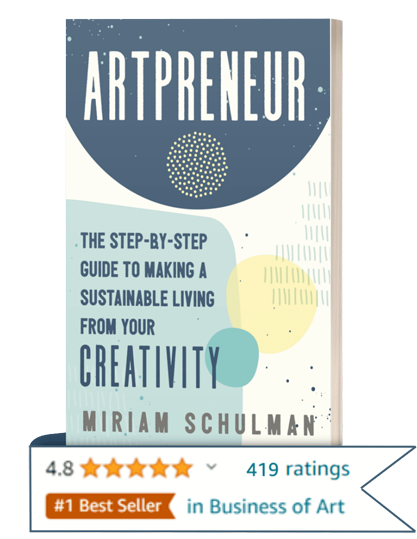
I feature her in my upcoming book Artpreneur when I talk about embracing your inner weirdo. Many artists suffer from anxiety and it’s one of the reasons that I have mental health experts on the podcast.
You can pre-order Artpreneur here.
Edvard Munch and The Scream
Edvard Much painted the scream a few years after his father passed away. He shared that the weight of the world had suddenly hit him. Growing up he was surrounded by death and depression and himself suffered with mental illness himself.
He said, “art comes from joy and pain, but mostly from pain.” I can relate to this. Maybe the art comes from pain, but it brings me great joy. Do you feel that way too?
Artist Agnes Martin and Mental Illness
Agnes Martin painted in a minimalist style but considered herself an part of the abstract expressionist movement. She suffered from hallucinations, depression and was often hospitalized and eventually diagnosed with schizophrenia.
She used subtle color and meticulously drawn grids to create a calming effect. About her work she said “art is the concrete representation of our most subtle feelings.
Her work is also part of the Paul Allen billion-dollar art action at Christies later this month.
Abstract Artist Mark Rothko on Overcoming Sorrow
Rothko’s striking color combinations are meant to be meditations. He wanted to create art church’s where people could look at art and pray.
He said “I’m interested only in expressing basic human emotions and the fact that lots of people break down and cry when confronted with my pictures shows that I communicate those basic emotions. The people who weep before my pictures are having the same religious experience that I had when I painted them.
Art has a spiritual effect on me. Does it affect you that way too?
Artist Paul Klee on Relieving Stress
Klee was a multi passionate artist who studied art and the violin. He was in his 30’s before he focused on his art career. Even then, he changed his style often to defy categorization.
He believed that creativity comes from beyond consciousness and that making art was a form of mediation. He said, “I paint in order not to cry.”
Why do you create art? I’d love to know.
Books!

About the host, Miriam Schulman
 Miriam Schulman is an artist business coach, working artist, and author of Artpreneur: The Step-by-Step Guide to Making a Sustainable Living from Your Creativity, published by HarperCollins Leadership. After building her own multiple-six-figure art business, Miriam created The Inspiration Place, a podcast ranked among the top 0.5% of podcasts worldwide by Listen Notes. Through her coaching programs, podcast, and book, she has helped thousands of visual artists strengthen their marketing, attract collectors, and build sustainable art businesses.
Subscribe & Review in iTunes
Are you subscribed to my podcast? If you’re not, I want to encourage you to do that today. I don’t want you to miss an episode. I’m adding a bunch of bonus episodes to the mix and if you’re not subscribed there’s a good chance you’ll miss out on those. Click here to subscribe in iTunes!
Now if you’re feeling extra loving, I would be really grateful if you left me a review over on iTunes, too. Those reviews help other people find my podcast and they’re also fun for me to go in and read. Just click here to review, select “Ratings and Reviews” and “Write a Review” and let me know what your favorite part of the podcast is. Thank you!
Listener shout out of the week!

Great help for artists
☆☆☆☆☆
I am an artist and I listen to this podcast regularly. I like the positive energy and practical advice.
~YingMcLane

I just OPENED the doors to the Artist Incubator program!
This program is PERFECT for artists 👩🎨👨🎨 who are ready to kick things up a notch when it comes to making a sustainable income from their art.
If that’s you, get ALL the details here!
👉 schulmanart.com/enroll
Other ways to enjoy this podcast
 |
Listen on Apple Podcasts |
|
 |
Read the transcript |
|
 |
Join the conversation on Instagram |



I love to paint , I first learned to paint watercolor and unfortunately she passed away. I would like to go back to that but I learned how to paint in Acrylic ,I learn more everyday thanks to all you professionals and my lap top . I have not tryed to price any or sell any yet . I am 80 now, but it makes me feel so good when I do a good painting. Thank you Miriam !